5k+ Satisfied Clients

Trusted by thousands of happy clients

24x7 OUR SERVICES

We are here for you, anytime
Hanuman

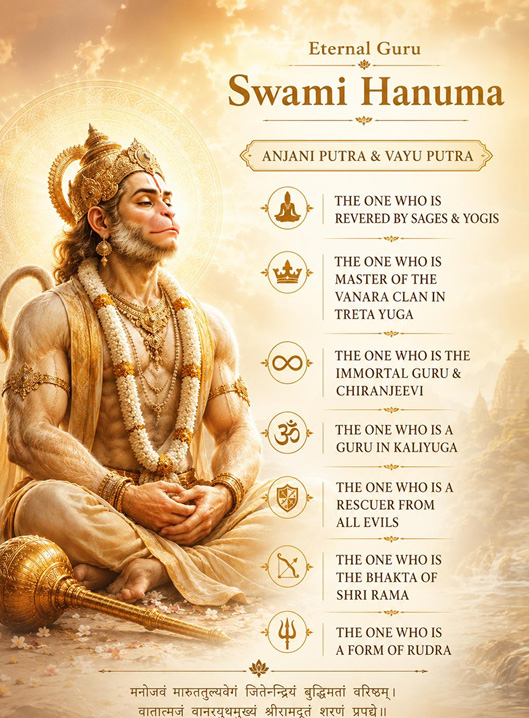
Eternal Guru - Swami Hanuma

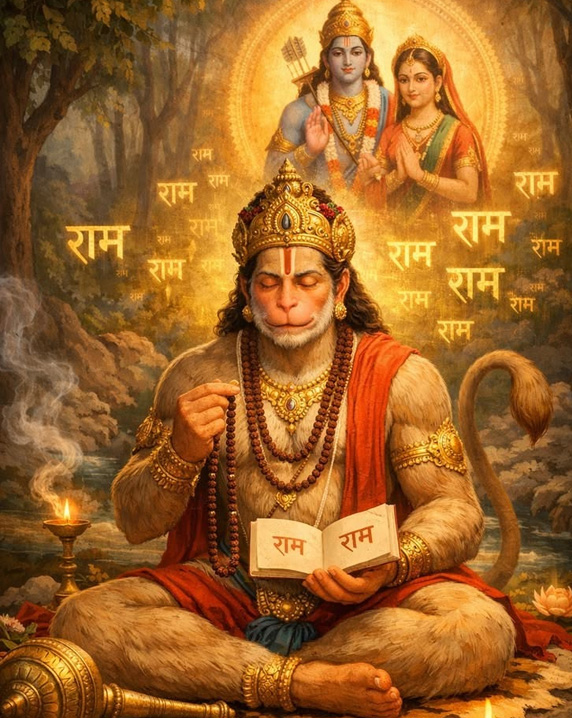
The Chiranjeevi , Immortal Guru , Parama Bhakta of Shri Ramachandra lives amnogst us even today , in these dark times of Kaliyuga. His name is a respite & refuge from all the dark and negative forces present.

He is Sarva Karya Siddhi . He can get his devotees out form any kind of problems , physical dangers or mental afflictions!

Because of his devotion, Ram granted Hanuman the boon of immortality (Chiranjivi). Hanuman is believed to remain on earth to protect devotees and listen to the chanting of Ram's name.

Wherever RAM NAAM is chanted Swami Hanuma is present!

He is the perfect balance of Bhakti Yoga , Karma Yoga & Gyaana Yoga.

There is No Ramayana without Hanuman, No Hanuman without Shri Ramachandra!

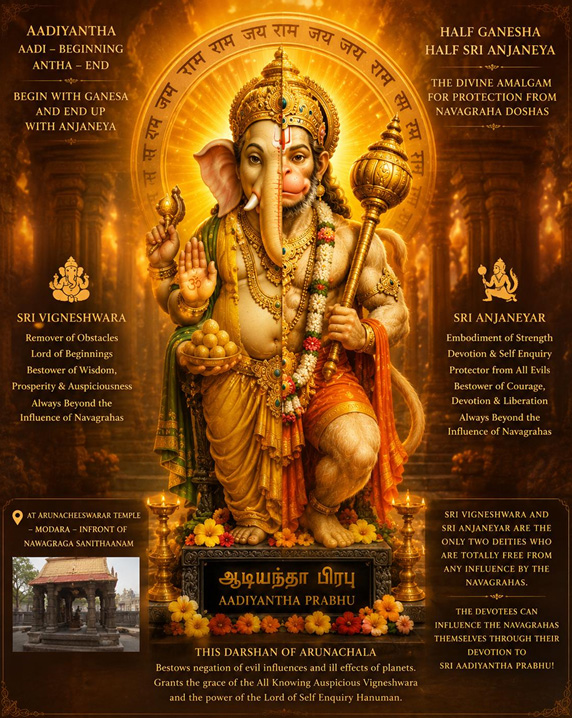
Half Ganesha and half Sri Anjaneyar At Arunacheleswarar temple – Modara – infront of Nawagraga Sanithaanam-The idol is an amalgam of Sri vigneshwara and Sri Anjaneyar on the lines of Ardhanareeswara ( Siva and Parvati) and Sri Sankaranarayanan (combination of Siva and narayana).The word Aadiyantha stands for 'begining to end' (Aadi - begining & Antha - end). There is a Tamil saying 'Begin with Ganesa and end up with Anjaneya'. Many people visit the temple to get blessing of the 'Twins' against the influence of Navagrahas. The importance of the idol is that Sri Vigneswara and Sri Anjaneyar are the only two deities who are totally free from any influence over them whatsoever by the Navagrahas. It is believed that, the devotees can and do influence the Navagrahas themselves proportionate to the devoutness with which the devotees address themselves to Sri Aadiyanta Prabhu!

This darshan of Arunachala carries in it the great Ganesha on the right and the powerful Hanuman on the left. A view or darshan of this aspect of Arunachala bestows us with negation of evil influences and ill effects of planets. It gives us the grace of the All Knowing Auspicious Vigneshwara and also the power of the Lord of Self Enquiry Hanuman.

Shri Ramachandra Ke Doota- Hanumantha Anjaneya

||Pavana Putra Hanumantha Balabheema Anjaneya||

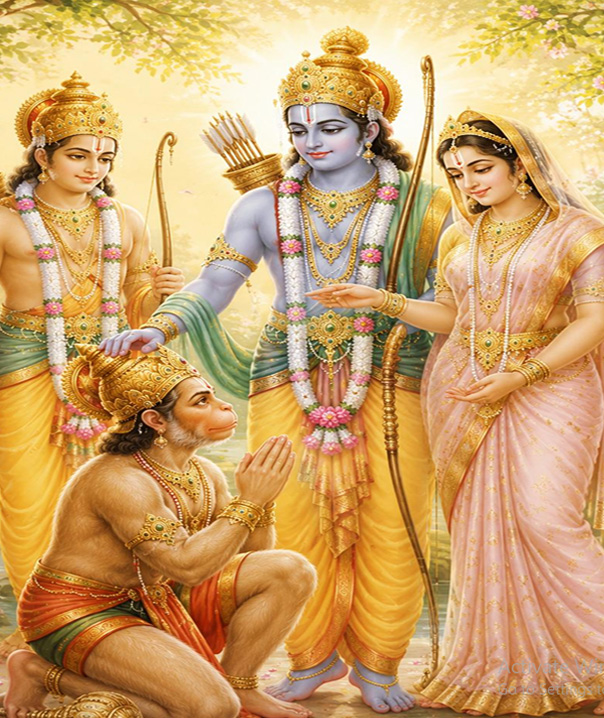
The bond between Lord Ram and Hanuman is the ultimate Hindu symbol of absolute devotion, loyalty, and selfless service.

The First Meeting: They met at Rishyamukha mountain in the Kishkindha forests while Ram and Lakshmana were searching for Sita. Hanuman recognized Ram's divinity instantly and pledged his eternal servitude.

Hanuman disguised as a Saint and approached Rama and Lakshmana. He said " You look like Rajarshis and Taapasis but are armed with swords, bows and arrows. Animals in this jungle are frightened due to your presence. Your eyes look like petals of lotus and you have a broad chest. You seem to be unbeatable in a fight and look like the saviour of the lives of many. But you seem to be gods disguised as humans. These contradicting observations surprise me."

Rama after listening to Hanuman, said to Lakshmana "Lakshmana, Did you observe how eloquent Hanuman was! There is nothing impossible for a king who has a minister like him. Even an enemy who came to kill them cannot act after he listens to Hanuman. A king is so lucky to have a minister like him, by analysing his words he seems to be well acknowledged with Rigveda, Yajurveda, Samaveda, Vyakaran (Grammar) and essence of the Upanishads. One can never talk like this without that knowledge. His eyebrows and forehead didn't move unnecessarily. His voice was neither too loud nor like mutter or whisper. He started, continued and completed his words in a single tone. He particularly knows how to spell each and every syllable. Sugriva is very lucky to have Hanuman as his minister. Convey him our purpose of presence in this forest."

Upon hearing their names and their mission, Hanuman immediately recognized the divine nature of Lord Rama. He was filled with devotion, dropped his disguise, and fell to Rama's feet, revealing his true identity.

Hanuman introduced Rama to Sugriva, explaining both of their plights (Sugriva had lost his kingdom to his brother Bali, and Rama had lost Sita to Ravana). They formed an eternal alliance of mutual aid.

Hanuman - His Boons & Curses

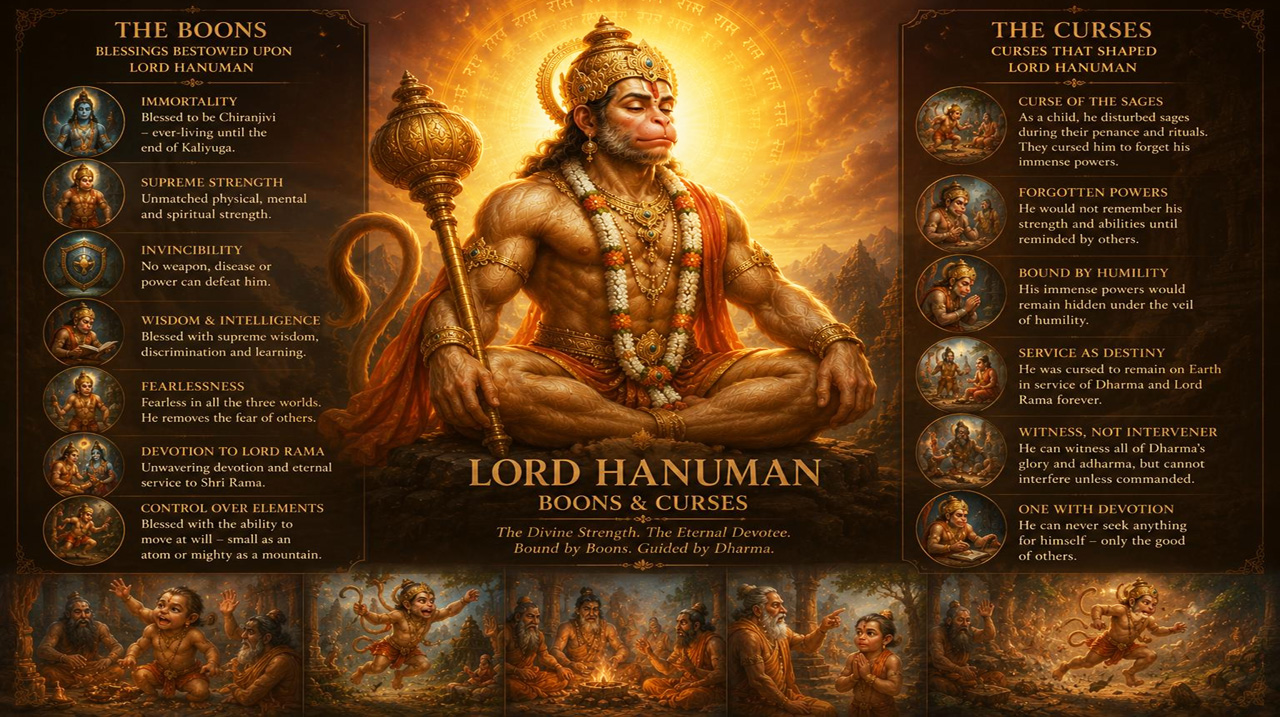
Hanumanji forgot his immense powers due to a combination of divine boons that made him unstoppable, and a measured curse from sages to curb his playful childhood mischief. The sequence of events is detailed in the Uttara Kanda of the Valmiki Ramayana.

As a child, Hanumanji mistook the rising sun for a ripe, golden fruit and leaped into the sky to catch it. To protect the cosmic order, Indra struck the child's jaw with his thunderbolt (Vajra), causing him to fall unconscious.

Infuriated by the treatment of his son, Vayu Dev (the Wind God) withdrew all air from the universe. To pacify Vayu Dev and restore life to creation, the principal deities gathered and bestowed unparalleled boons upon the young Hanuman:

  • Lord Brahma: Granted immunity against any weapon or curse from Brahmins, and the ability to change his size or form at will.
  • Indra: Declared that Hanuman's body would be as hard as a diamond, and no celestial weapon could ever harm him.
  • Varuna & Agni: Blessed him with absolute immunity against water and fire.
  • Yama & Surya: Granted him freedom from fear of death and endowed him with unmatched speed, scriptural knowledge, and illumination.

THE CURSE OF THE SAGE

Armed with these grand blessings, Hanumanji grew immensely powerful, fearless, and overflowing with energy. As a highly energetic child, he began using his vast strength for restless pranks.He regularly visited the forest ashrams of great ascetics like Sage Matanga and sages from the Bhrigu and Angira families. His innocent yet highly disruptive play included:

Disturbing deep meditation.Breaking sacrificial vessels and dousing holy ritual fires.Tearing up holy garments and uprooting large forest trees.Because of Lord Brahma's boon, the sages could not physically punish or harm him. Realising that unchecked power without emotional maturity could become chaotic, the sages pronounced a measured, protective curse:

"O Vanara, you will remain entirely unaware of your own divine strength and celestial boons for a long time. Your immense powers will lie dormant, and you will only remember them when a wise and worthy being reminds you of your true glory."
Hanuman & Jambhavan

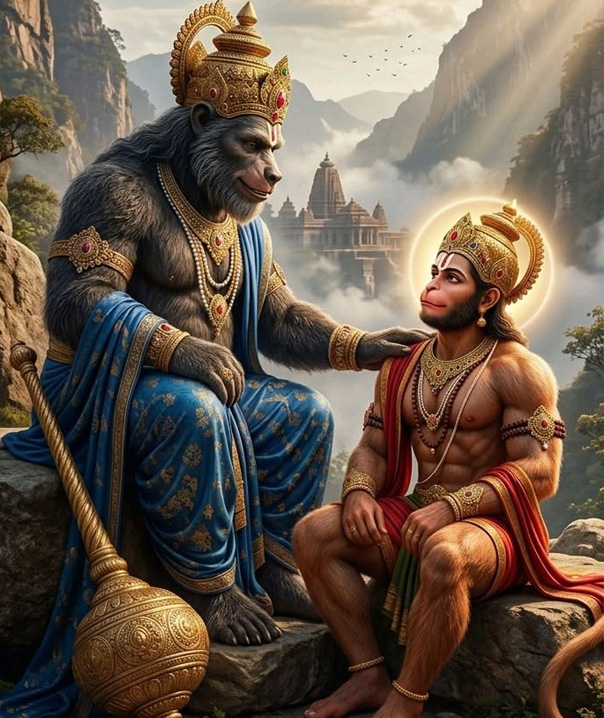
The Awakening by Jambavan

Hiscurse acted as a safety shield, keeping his ego and supreme power in check throughout his youth.

Years later, on the shores of the southern ocean, the Vanara army stood disheartened by the impossible task of crossing 100 yojanas of sea to Lanka. It was then that the wise elder, Jambavan, stepped forward. He narrated the tale of Hanumanji’s birth, Vayu's blessings, and the glorious boons of his childhood. As Jambavan spoke, the veil of the sages' curse dissolved, instantly restoring Hanumanji’s colossal powers and setting the stage for his leap to Lanka.

Jambavan reminded Hanuman that he was the son of Vayu (the wind god), possessing boundless speed, courage, and intelligence

He compared Hanuman’s might and vigor to that of Garuda (the king of birds), assuring Hanuman that no one else had the capability to achieve this feat.

Because of a childhood curse, Hanuman had temporarily forgotten his own abilities. Jambavan’s mentorship acted as a catalyst, restoring Hanuman's self-belief and prompting him to grow to his colossal size to cross the sea.

Hanuman symbolises the soul (jiva) ,that haa forgottenn his divine strength due to ginoracne or ego.Jambhavan represents spiritual wisdome & faith the reminder that awakens our inner divinity. The soul realises that “ I am capable because I am guided by the Divine”

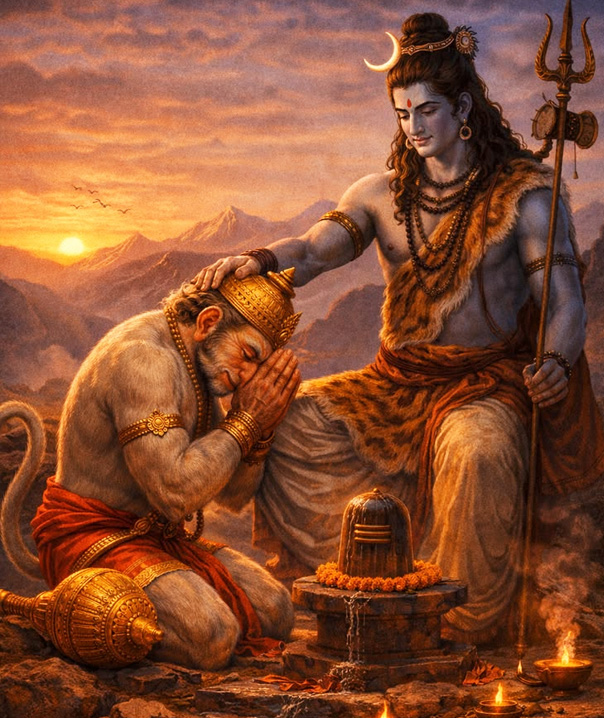
Hanuman & Lord Shiva

Ananad Ramayana and Shiva Purana that he was An Avatar/ Ansha of Lord Shiva.

When Vishnu agreed to be born as a human to defeat Ravana, Brahma felt that he would need help, so he asked Shiva to incarnate as well. Shiva decided to be born as Hanuman, son of the wind god Vayu and the nymph Anjana, who was born on earth as a monkey princess due to the curse of sage Durvasa.

Lord Hanuman was born on Tuesday on the full moon day of Chaitra month. Tuesday is considered a very auspicious day for the worship of Lord Hanuman.

In the Ramcharitmanas Lord Shiva, knowing Hanuman would serve the Lord, actually orchestrated their first encounter during Shri Ram’s childhood in Ayodhya.

Lord Shiva disguised himself as a wandering monkey trainer (Madari) and took child Hanuman—who was also disguised as an ordinary monkey—to King Dasharatha's palace.

They performed amazing tricks and entertained the young princes.

Shri Ram realized the monkey was no ordinary animal and happily played with him. When the Lord set Hanuman free, He smiled and promised they would meet again in the future.

Mentions of Hanuman as RUDRA AVATAR-

Shiva Purana – Incarnation of Lord Shiva

Agastya Samhita – Lord Shiva placed him in the womb of Anjana (Hanuman's mother)

Sri Vaishnav Matabaja Bhaskar - Lord Shiva chose to become Anjana's child

Tulsidas's couplet - After Shiva left his Rudra form, he incarnated as Lord Hanuman

Vadvalan Stotra - Vibhishana called Lord Hanuman 'Rudravatar'

Anushishna Parva, Mahabharata - Incarnation of Lord Shiva

Hanuman Chalisa - Shankar Suvan (Incarnation of Lord Shiva

Narada Purana – Hanuman form of Lord Shiva

Skanda Purana – Indirect incarnation of Lord Shiva

The search for Ma Sita

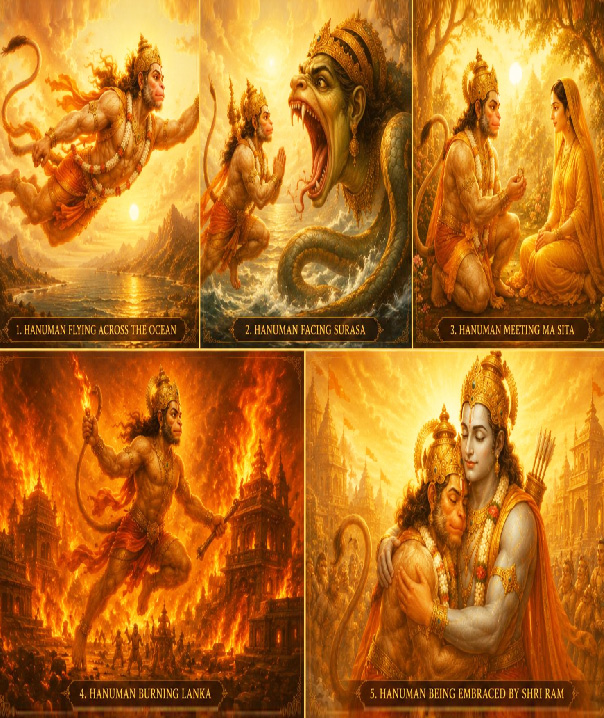
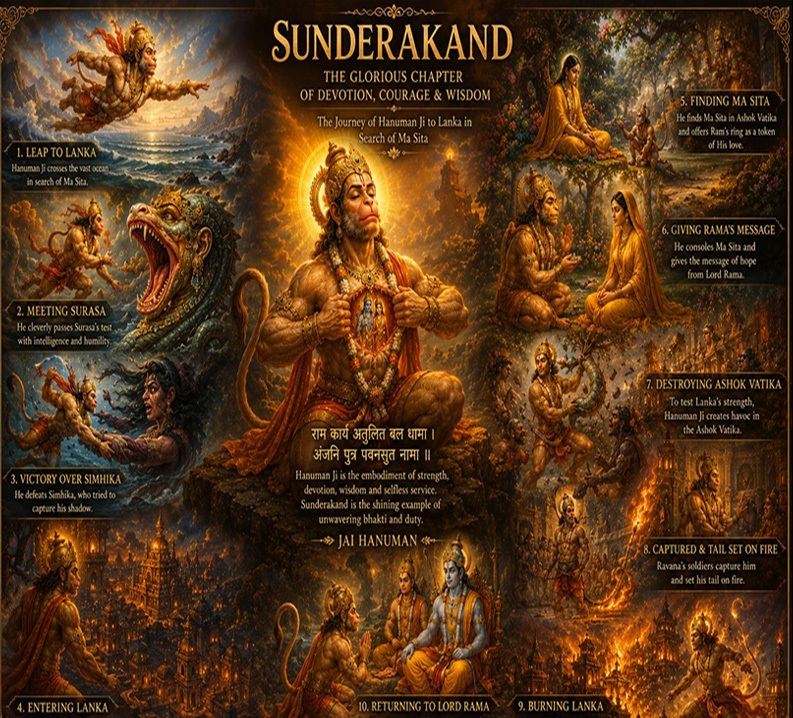
The Search for Ma Sita ,Propelled by his devotion, Hanumanji leaped across 100 yojanas of water.

During the flight, his path was tested by the sea demoness Simhika, and the mother of the Nagas, Surasa, who challenged him to enter her mouth. He overcame both with his wisdom and strength.

When he returned, Ram embraced him—a gesture that remains one of the most revered acts of love in the epic.

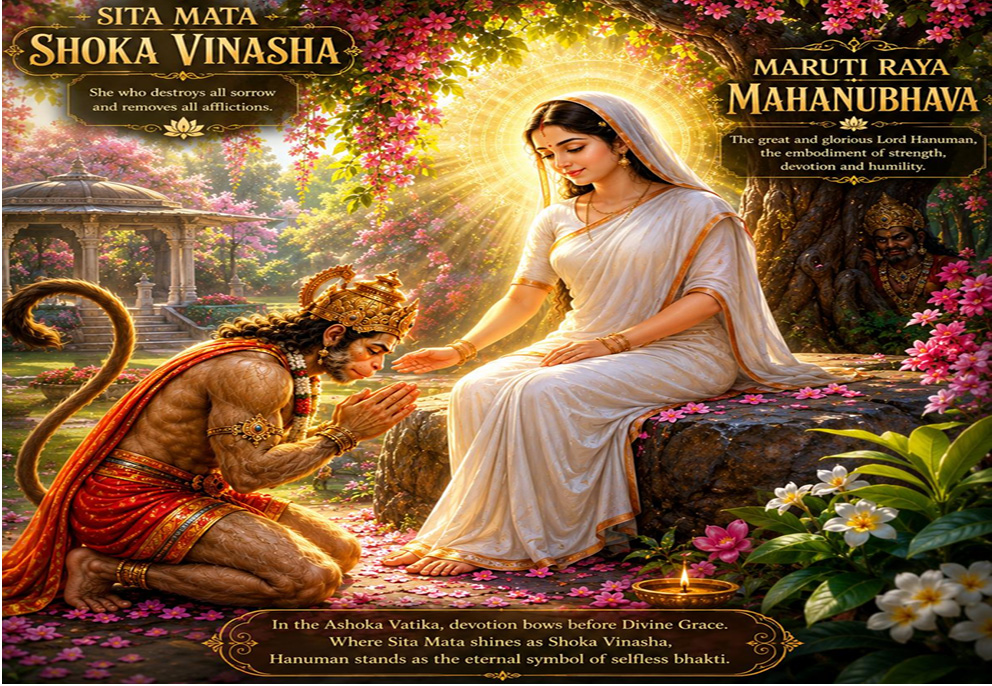
Hanuman, in his tiny form, reached Ashok Vatika, where he saw Sita sitting alone under a tree, focused on prayer and mentioning Rama's name. Hanuman knew this was the woman he was searching for.

When the demonesses guarding Sita were asleep, Hanuman approached her and introduced himself as Ram-Doot Hanuman, sent by Lord Rama to find her. Sita's eyes lit up upon hearing Rama's name, and Hanuman showed her Rama's ring as proof.

Sita told Hanuman about her situation and refused to go with him, insisting that Rama should come himself to rescue her and punish Ravana. Hanuman respected her wish and received a jewel, Chudamani, from Sita to give to Rama as a token of her love and faith.

Before leaving, Hanuman destroyed the garden and killed many of Ravana's warriors, showcasing his powers and leaving a message for Ravana. His father, Vayu Dev (the Wind God), began blowing heavily, fanning the flames across the entire capital. The intense heat was so fierce that the golden walls of Lanka actually began to melt and run down the streets.

He carefully kept his distance from the Ashoka grove to ensure Maa Sita remained entirely safe and untouched by the smoke or flames.Vibhishana’s House: He deliberately spared the residence of Vibhishana out of respect for his righteousness and hospitality.

When Maa Sita heard from the demonesses that Hanumanji's tail had been set ablaze, she prayed intensely to Lord Agnideva (the Fire God), chanting: "If I have been faithful to my husband, please remain cool to Hanuman." In response, the fire blazed brightly but became completely cold to Hanumanji, causing him absolutely no pain or burns.

Esoteric Meaning Of Sunderakand

The Ocean (Samsara): The vast sea Hanuman crosses represents the ocean of worldly illusions, attachments, and material desires that separate the individual soul from the Divine.

Hanuman (The Mind/Prana): Hanuman symbolizes the purified mind, unwavering willpower, and the prana (life force). He is the spiritual seeker’s inner potential.

Lanka (The Ego): The golden city of Lanka represents the ego-driven mind. It is built of gold (representing worldly wealth and desires) and ruled by Ravana and his demons (symbolizing greed, anger, and delusion).

Sita (Bhakti/Devotion): Sita represents Divine Grace and pure devotion. She is trapped in the Ashoka Vatika (a state of sorrow and separation from God) inside the ego's fortress.

To reach Sita, Hanuman must awaken to his true, dormant power (symbolized by Jambavan reminding him of his strength). On his journey, he overcomes various inner obstacles:

Surasa (The Ego Test): Surasa, the sea monster who widens her mouth to swallow Hanuman, represents arrogance and pride. Hanuman defeats her not by brute force, but by becoming tiny— symbolizing humility.

Simhika (The Shadow Self): Simhika, the demoness who catches shadows, symbolizes hidden, subconscious negativities. Hanuman destroys her by recognizing the root cause of the obstacle.

The Burning of Lanka: Hanuman's burning of Lanka represents the concept of Vairagya (detachment). It signifies using a focused, purified mind to burn away worldly illusions and egoistic attachments.

Why is it called "Sunder"?

"Sunder" translates to beautiful. This section is considered the most beautiful because it highlights how a seeker, armed entirely with devotion, faith, and humility (rather than fighting like a traditional warrior), transforms sorrow into joy and reunites with the ultimate consciousness, Lord Rama.

Sita As Maha Tripura Sundari

The rarest method of this is to read the Sundarakandam with the objective of obtaining Sita's blessings.That is Asya Sri Sundarakanda Stotra Mantrasya Sri Sita Mahatripura Sundari Devata. That Sita becomes the Devata over here.Now if you view this aspect of the Sundarakandam, you will see from the first shlokam of the Sundarakandam onwards, Valmiki suggests that Hanuman and Sita no longer are characters. It is about a Sadhaka that is about to have Darshanam of Mahatripura Sundari.And here is where we can see some beautiful correlations. After her Aparaharanam, she has gone to Lanka.Lanka is a Dweepam. It is an island in the middle of an ocean. And when Valmiki describes that island, he describes each of the enclosures in Lanka with all the trees, all of the jewels, the entire,the island is one of the most, it is a spectacle in itself to see. And as Hanuman goes enclosure by enclosure inside, he comes closer and closer to Sita.

This exact idea, Adi Shankaracharya depicted and I will represent this with a shlokam.This is one of the gems in the Soundara Lahari. Now look at the corelation that this is Manidweepam, where Lalitha Mahatripura Sundari resides, is a place of absolute joy. She, over there, there is absolutely no sorrow. And what is the vanam in which Sita is placed? Ashoka vanam. She herself has no shoka.That is why she is in the center of that vanam and when Hanuman goes there to look for Sita, that searching is not an easy process. Because that searching is what we call as anveshana in sadhana.The process of finding your Ishta Devata, that is not an easy process. And Valmiki's chamatkaram lies in how he also numbers the episodes.

In the Sundarkanda of 68 sargas, there are two very important sargas.The first one is, of course, there are many many gems in Sundarkanda. This is not to reduce from that. But look at the chapter in which Hanuman is about to give up. In that chapter, Hanuman's mental disposition drops in absolutely no time. He says, I have not found her. And if I don't find her, then Rama is going to be disappointed. If Rama is disappointed, Rama will die. If Rama dies, then something will happen to Lakshmana. If Lakshmana goes, Bharata and Shatrughna will go. If Bharata and Shatrughna go, Kausalya, Sumitra, all of them will go. Ikshvaku Vamsham will go. The Vanara Kulam will go. Everything will be gone, all because of me. In a few steps, that's it. And that's very relatable for all of us. This is a normal process in sadhana. But when Hanuman slips over there, internally, he finds some resilience. And internally, this happens in the 13th chapter, where he says, I will stay alive.

That finding life and staying alive is a blessing. When he conquers his sorrow like this, which happens in the 13th chapter, because 13 is the exact digits in the Rama Taraka Mantram.Shriram Jayaram Jay Jayaram. When Hanuman attains that Rama Mantra Siddhi, then in that chapter, he says, oh, there is an Ashoka Vanam. When does he find the Ashoka Vanam? When he goes beyond his own shokam with Rama Mantra Siddhi.So from here, when Hanuman says, I will go in the Ashoka Vanam and I will find her, we then see how as he goes closer, he finds her in the 15th chapter.In the Srividya Upasana, the Panchadashi Mantram is the ultimate Mantram of the Mother Goddess.That Mantram, which cannot be disclosed in Sabhas, has 15 syllables.15 syllables over there, 15th chapter is the first time Hanuman has darshanam of Ma Sita.So when Hanuman has that beautiful darshanam of Ma Sita, before he does, now we see Hanuman as a sadhaka, establishing who is this Goddess.When he sees her for the first time, he makes a series of comparisons.He tries, he looks at her and Hanuman'sown poetry comes forth and Valmiki's poetry as well, where Hanuman says, she looks like Agni that is covered by smoke.She looks like a smriti text that is filled with doubt.She looks like buddhi that has been started on the first day after Poornima.Because if anybody starts learning anything on the first day after Poornima or Amavasya, that is on Padyami, that buddhi, sheenam, it becomes lesser.So he sees all of her brightness, but he also sees that she has waned.

Hanuman's own understanding of Ma Sita also changes by this time.This Devi who is now in the form of Janaka's daughter, I am bowing down to her. When he has this, she doesn't deny him the darshanam anymore and as he goes forward, when he eventually sees her, this is the beauty. Hanuman, if he was just a vanara or if he was just a human, he would have used some quick logic to conclude who she is because his first establishment is through her physical attributes. So he says, look at all the ornaments that she is wearing. Ramachandra described to me in Kishkindha Kandam, Ramachandra describes to him what all she is wearing on which angam of hers. So he says, as per Swami's description, identical she is matching. So when he does that, he makes the first thing, saying whatever Rama has said, I can see this. Second aspect, whatever she dropped when she was going with Ravana, whatever she dropped from the Pushpak Vimanam, those abharanas are missing on her body. Third, she tied them quickly into a cloth.

So I can understand therefore that this is the same cloth and he does the match the following like many people do in blouse shops. So he is established. But if he were a vanara, he would stop here. If he were a human mind, he would stop here. A sadhaka is not looking only for the physical attributes. A sadhaka is looking for the divine lakshanas within her. And Valmiki gives us two beautiful slokas that talk about two very important principles in Shakti Sampradaya, in Shakta Sampradaya.The first slokam is Asya devya yatha roopam. This Devi's form yatha roopam. Anga pratyanga saushthavam.Her every anga, her every limb. How is it? Ramasyacha yatha roopam. How Rama is in his every limb.Asyayam asitekshana. That's exactly how she is. Now this is samayacharam.This is the concept of samayacharam that they match each other. This is exactly Adhanarishwara tattva.That when you see them both together, they match so perfectly.If you have ever seen an image of Adhanarishwara, they are not disproportionate.In the same body, there is so much of duality happening, but they are so beautifully put together because Shiva and Shakti are inseparable.That idea which comes as the last word of the Lalita Sahasranamam. Shri Shiva shiva shaktyaikya Roopini Lalitambika.

She who is the merging of Shiva and Shakti.Here Valmiki depicts saying she who looks exactly like Rama.This is his one slokam that suggests that Hanuman sees Rama and Sita.I.Next shlokam begins with the same words. Asya devya manastasmin asyachasyam pratishthitam.

This Devi who is seated here, she has Raghava firmly in her mind and Raghava has her firmly in her mind. That is exactly why denayam such a dharmatma muhurtam api jivati. Why is she alive? She is alive only because she has Raghava in her mind and Raghava has her in his mind. This aspect is about Purusha and Prakriti. Only as long as Purusha wishes will Prakriti exist outside. If Purusha doesn't want it, all of it will go back into him and only as long as Prakriti wishes will Purusha remain engaged. Without both of them wanting each other like that there will not be any samsara. So then Sita gives him darshanam after these beautiful shlokams .When we look for Sita as Tripura Sundari, there are points in the Sundarakandam, it comes out where you cannot hide it anymore. Because even when Hanuman is conversing with her, you can hide it because she is sad. She herself is in Ashoka Vanam, but she is in Shokam. So you can see the human elements of the story that come out here and the heart goes out to that Sita as well. So let him come and do his work and further as the katha goes on, Hanuman meets her and he tells her, I will leave now, I will take your leave. Hanuman says that not me, I am still here for a few minutes and when Hanuman says this to her, he says I have a small thing to do. I will finish that small thing. That small thing is Lankadhanam. Here is something to pause and see. When Jaganmata is angered, Jaganmata's anger as we said equates to sarvam, everything is destroyed. This is not the only form of Jaganmata who destroyed. Look at the context of Sita and Ravana. Ravana wants Sita for himself, which means that he does not see her as Rama's ardhangini. He thinks Rama is separate, Sita is separate. The second you separate Purusha and Prakriti and you want Prakriti alone, that you believe you can manipulate Prakriti and have her as your own, your destruction is very near. The minute you do not want to see Purusha along with Prakriti, you have limited Prakriti to just what you are seeing in front of you.To remind you that she is eternally his, she will bring you down to bhasmam and that is why Hanuman goes to do Lankadahanam.But when Hanuman does Lankadahanam, Sita with all her tapas emerges for us.

Valmiki says. He says that she is seeing, she is in the middle of Ashoka Vanam, there are Rakshasis all around her. All of this is happening. But for her, she sees Rama and Rama alone. If you go into Manidweepam, which is not that easy to go into, but there when you see Lalita Mahatripurasundari, Lalita Mahatripurasundari's eyes are not open, contradicting the pictorial depictions that we have. Lalita Mahatripurasundari's eyes are almost open. They are slightly open as a matter of fact. Because as the Ashtottram says, her eyes are closed and she is constantly contemplating on her husband and that is what is making Lalita smile. Sita has the same smile in her because she is thinking of Rama. So this beautiful aspect comes out and when she is thinking of Rama, who is a Dharmatma, Sita's own dharma is not anything less. So what happens is Hanuman goes out for Lanka Dahanam and one of the Rakshasis comes and tells Sita that, you know, are you aware that monkey that came and spoke to you, that monkey's tail is being burnt. So he is being taught a lesson for what he did. At this point, Sita panics because she says he has come just for my sake. Now he has come for my sake and his tail is going to be burnt. Is it fair? This is where you distinguish that this is not a human being. If it is a human being, you will pray. You will just say, I hope Hanuman is okay. Sita does not say that. Sita presents the dharma that she followed and uses that dharma to negotiate what should come for Hanuman. Because when we look at this, we understand why she is a Dharmaswarupini herself.

She makes four shlokams, all ending with the same four lines, Shito bhava hanumataha, may Hanuman be cool. If this dharma has value, Shito bhava hanumataha, Hanuman will, Hanuman's tail will be cool. What is that dharma?

She says, Yadimam vrittasampannam, if I have been true to my vratam, my vratam of what? My pativratam.

Yadimam vrittasampannam, if I am waiting to be with him, with what? Manasa, vacha, karmana.

If my mind, my speech and my actions want to be with him and him alone, look at the layers.

Yadimam vrittasampannam, if I have been true to my vratas and if I have want to be with him and him alone and a third clause, Savijanati dharmatma, if that dharmatma, Ramachandra knows this, then let Hanuman's tail be cool.

So when does she say, what is the layering of our dharma?

That if all these things are true, Hanuman's tail will be cool.

And sure enough, Hanuman's tail is very much cool and when Hanuman looks at his tail, he has burnt all of Lanka, he looks at his own tail and he said, how is it that my tail is not burning?

How is it that I am not feeling anything at all? And he says three beautiful things. One of them is Ramaprabhavadashcharyam. I am amazed at the prabhava of Rama that can protect anybody anywhere. And the second thing is, this is because of the tapas of Sita that I am protected.

At various points, Hanuman uses Agni references to talk about Sita, because Hanuman understands that this Mahatripurasundari is the same one that is spoken about in the Durga Suktam, where he says, Tam agnivarnam tapasajjvalantim vairochanim karmaphaleshu justam durgam devigum saranamaham prapadyesu tarasitarase namaha.- I am bowing down to that goddess who is Agnivarnam and who is Karmaphalapradayini.

In the Lalita Sahasranamam, This comes exactly in the Dharadharasuta Dhanya Dharmini Dharmavardhini. The one who is in Dharma herself and is an epitome of Dharma as we just showed you.

Panchamukhi Hanuman

During the battle of Lanka, Lord Lakshman kills Indrajit, son of Ravana, by beheading him with the Anjalikastra. When Ravana gets this news, he spills with anger and turns to his brother Ahiravana, the king of the underworld, for help.

Ahiravan was a master of illusion and deceit. When Vibhishana comes to know that Ravana has joined hands with Ahiravana to avenge the death of his son, Indrajit, he alerts Lord Hanuman. Vibhishana warns Lord Hanuman about Ahiravana and advises him to guard the cottage of Lord Rama and Lakshman as Ahiravana would try to abduct them. Lord Hanuman stood guard outside the cottage where Lord Rama and Lakshman were resting. Ahiravana tried to enter the cottage, but all his futile efforts were denied by courageous Lord Hanuman. Feeling helpless, Ahiravana creates a spell that puts everybody to sleep and, disguised as Vibhishana, deceives Lord Hanuman. He enters the cottage where Lord Rama and Lakshman are resting and takes them to his underworld.

In the morning, when Vibhishana & Lord Hanuman comes to know that Ahiravana has kidnapped Lord Rama & Lakshman, Lord Hanuman bursts with anger and travels to Pataal Lok to kill Ahiravana and rescue his beloved deities. As he approaches the door of Pataal Lok, he is stopped by his son Makardhwaja. Then, with his immense strength and power, Lord Hanuman defeats Makardhwaja and enters Ahiravana’s palace, where Lord Rama & Lakshman are held captive.Ahiravana had a boon that he could only be killed if all the 5 diyas or lamps that he lit in 5 different directions were blown off simultaneously. When Lord Hanuman enters Ahiravana’s palace, Chandrasena guides him on how to kill Ahiravana and rescue Lord Rama and Lakshman.

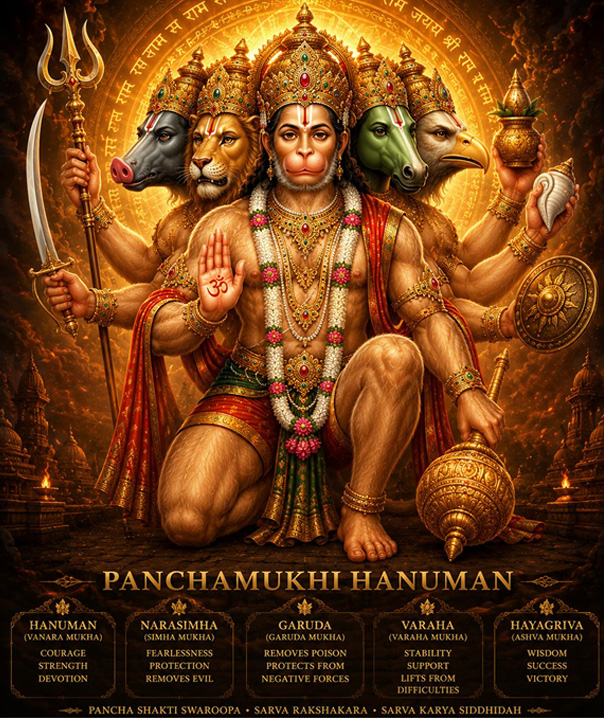
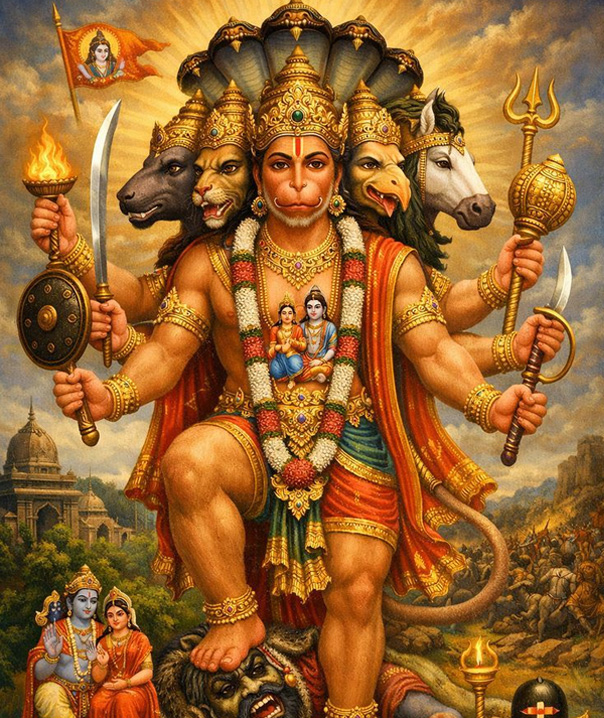
To blow the five lamps in five different directions, Lord Hanuman takes the form of Panchmukhi Hanuman and blows all 5 lamps simultaneously to kill Ahiravana.Then Lord Hanuman takes Lord Rama and Lakshman out of Pataal Lok and fulfills his promise to keep his beloved lord safe and sound.

Every face of Lord Hanuman’s Panchmukhi avatar is associated with or an incarnation of Lord Vishnu that depicts the win of good over evil in different aspects.

1. Shri Hanuman – (Facing East)

It represents the removal of all stains of sin and the establishment of mental peace in your life.

2.Garuda – (Facing West)

Garuda, also known as the vehicle of Almighty Vishnu, symbolizes the removal of all harmful influences in your body as well as the drive away of evil spells and negative spirits.

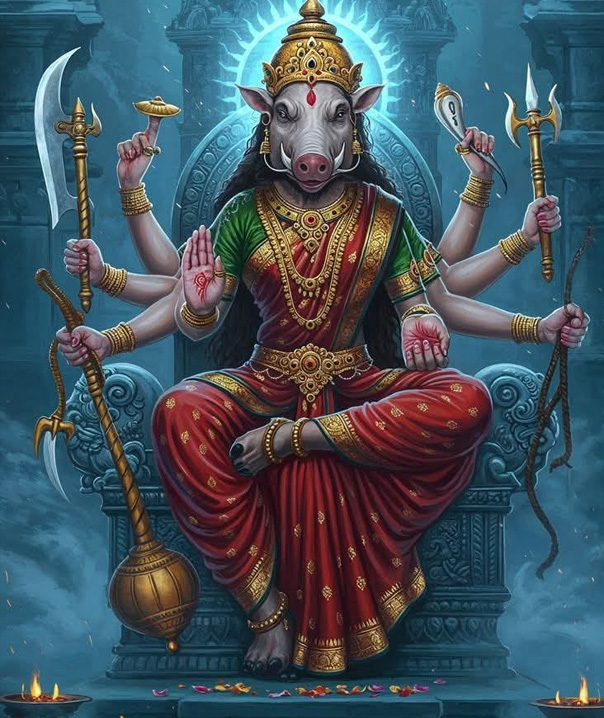
3. Varaha – (Facing North)

This wild boar incarnation of Lord Vishnu represents stability and restoration of balance. The Varaha face symbolizes the power of Earth to support life and create harmony in the world.

4. Hayagriva – (Facing Upwards)

Lord Vishnu took this horse-faced form to defeat the Hayagriva demon. This form is associated with wisdom, knowledge, and enlightenment. The upward direction of the face represents divine understanding and wisdom.

5.Narasimha – (Facing South)

This face is a very celebrated form of Lord Vishnu as he incarnated as Narasimha to protect Prahalad from his father, the asura king, Hiranyakashipu. This face represents intellect, righteousness, and victory.

He holds five revered weapons: Gada (mace), Parashu (axe), Chakra (disc), Trishul (trident), and Khanda (sword), symbolizing immense divine power.

Each face signifies divine aspects: Shri Hanuman grants purity, Garuda removes negativity, Varaha ensures stability, Hayagriva bestows wisdom, and Narasimha upholds righteousness.

Meaning / Translation of Hanuman Chalisa

The Hanuman Chalisa was written in the 16th century CE.It is attributed to the renowned poet-saint, Tulsidas.

With the dust of Guru's Lotus feet, I clean the mirror of my mind. I narrate the pure glory of Sri Raghuvara (Rama), which bestows the four fruits of life (Dharma, Artha, Kama, and Moksha).

Knowing my body to be devoid of intellect, I remember the Son of the Wind (Hanuman). Grant me strength, wisdom, and knowledge, and remove my miseries and impurities.

  • Hail Hanuman, the ocean of knowledge and virtues. Hail, the chief of the monkeys, who is renowned in all three worlds.
  • Messenger of Rama, abode of immeasurable strength, known as Anjani's son and also as the son of the Wind God.
  • Great hero, mighty as thunderbolt, dispeller of wickedness, and companion of good sense and wisdom.
  • Golden-hued, splendidly adorned, wearing earrings, and with curly hair.
  • Holding a thunderbolt and a banner, wearing the sacred thread made of munja grass on the shoulder.
  • Son of Lord Shiva and Kesari, whose glory is revered by the entire world.
  • Endowed with wisdom, virtue, and sharp intellect, always eager to perform tasks for Rama.
  • Delights in listening to the deeds of the Lord, resides in the hearts of Rama, Lakshmana, and Sita.
  • Assumed a diminutive form to appear before Sita, then assumed a fearsome form to burn down Lanka.
  • Assumed a gigantic form to slay demons, thereby completing the tasks of Lord Rama.
  • Brought the Sanjeevani herb to revive Lakshmana, bringing immense joy to Lord Rama.
  • Rama praised you greatly, saying, "You are as dear to me as my brother Bharata."
  • "Thousands of mouths sing your glory," says Lord Rama, embracing you
  • Sanaka and other sages, along with Brahma, the great hermits, Narada, Saraswati, and the serpent king.
  • Yama, Kubera, and the guardians of the directions; even poets and scholars cannot describe your glory.
  • You rendered a great service to Sugriva by introducing him to Rama, who then crowned him king.
  • Vibhishana accepted your counsel, and became the king of Lanka, known throughout the world.
Meaning / Translation of Hanuman Chalisa

  • You leapt towards the Sun, thousands of miles away, thinking it to be a sweet fruit.
  • Carrying Lord Rama's ring in your mouth, you crossed the ocean effortlessly, no wonder.
  • All the difficult tasks in the world become easy with your grace.
  • You are the gatekeeper at Rama's door; without your permission, none can enter.
  • All happiness is gained by taking refuge in you; when you are the protector, there is no fear.
  • You alone can control your power; all the three worlds tremble at your roar.
  • Ghosts and evil spirits do not come near, when one utters your mighty name.
  • Diseases are destroyed, and all pains vanish when your name is constantly chanted, O brave Hanuman.
  • Hanuman saves from crises, those who remember him in thought, word, and deed.
  • Rama is the supreme ascetic king; you accomplished all his tasks.
  • Whoever comes with any desires to you, achieves the abundant fruits of life.
  • Your glory prevails through the four ages, and your fame radiates brightly throughout the world.
  • You are the protector of saints and sages, the destroyer of demons, and dear to Rama.
  • You can bestow the eight supernatural powers and the nine treasures; this boon was given to you by Mother Sita.
  • You possess the elixir of devotion to Rama, and always remain his faithful servant.
  • By singing your praises, one finds Rama and forgets the sorrows of many lifetimes.
  • At the end of life, one goes to the abode of Rama and is known as a devotee of Hari.
  • One does not need to pay attention to any other deity; all happiness comes from serving Hanuman.
  • All crises are removed, and all pains vanish for those who remember the brave Hanuman.
  • Hail, Hail, Hail, Hanuman!
  • O Lord, bestow your grace as the supreme Guru.
  • Whoever recites this Hanuman Chalisa a hundred times is released from bondage and enjoys great happiness.
  • Those who read the Hanuman Chalisa gain success, with the blessings of Lord Shiva & MA GAURI as a witness.
  • Tulsidas, always the servant of Hari, prays to make your abode in his heart.
  • O Son of the Wind, remover of distress, embodiment of auspiciousness. With Rama, Lakshmana, and Sita, dwell in my heart, O King of Gods
Vadvanal Stotra

The Hanuman Vadvanal Stotra is a powerful Sanskrit hymn dedicated to Lord Hanuman. Attributed to Vibhishana (Ravana's brother), it is traditionally recited to invoke Hanuman's fierce, protective energy to burn away fears, neutralize negative planetary influences, and dissolve life's impossibilities.

Together, the "Vadvanal Stotra" invokes Lord Hanuman as this all-consuming divine fire—not to destroy, but to purify and eliminate inner negativity, karmic blockages, black magic, and diseases.

Vadvanal refers to the mythical, ferocious, and unquenchable fire that exists deep beneath the ocean. It is highly transformative, possessing the power to dry up the entire ocean and burn anything in its path.

Shri Ganeshaaya Namaahaa

II Om asya Shri Hanumaan Vadvaanal Stotra Mantrasya II

II Shri Ramachandra Rushiihi II

II Shri Vadvaanal Hanumaan Devataa II

II Mama Samasta Roga prashamanaartham SitaRamachandra priithyartham II

II HanumanVadvanal Stotra japam Aham karishye II 1 II

II Om Rhaam Rhim Om Namo Bhagvate Shri MahaHanumate Pragatparaakram II

II Sakaldig Mandal Yashotavitaana DhavaliikrutJagatritaya VajraDeha II

II Rudraavataara Lankaapurii Dahana UmaaAmala Mantra Udadhi Bandhana II

II DashaShiraha Krutaantaka SitaSwasana Vaayuputra AnjaniGarbhaSambhuta II

II ShriRaama LaxmaNaananadkara KapiSainyapraakaara Sugriivasahaahya II

II RaNapartotpaaTana kumaarBrahmachaarin Gabiirnaada II

II SarvaPaapaGarhaVaaraNa Sarvajvarochhaatana DaakiniiVidhanvasana II 2 II

II Om Rhaam Rhim Om Namo Bhagvate Mahaaviiraviiraaya Sarvadhu:kha Nivaaranaaya II

II Graha Mandala SarvaBhoota Mandal SarvapishaachaMandalochchatana II

II Boota Jwara Ekaahika Jwara Dwayaahika Jwara Tryaahika Jwara II

II Chaaturthika Jwara Santaapa Jwara Vishama Jwara Taapa Jwara II

II MaaheSvara VaiSnavaJwarana Chhindhi Chhindhi YakshabrahmaRakshasa II

II Bhoota Preta Pishaachaan Uchchaataya Uchchaataya II 3 II

II Om Rhaam Rhim Om Namo Bhagvate Shri MahaHanumate II 4 II

II Om Rhaam Rhim Rhum Rhaim Rhaha Aam Haam Haam Haam Oum Soum Ehi Ehi II

II Om Ham Om Ham Om Ham Om Ham II 5 II

II Om Namo Bhagvate Shri MahaHanumate ShrvanChakshu Bhutaanaam II

II ShaakiniiDaakiniinaama VishamaDushTaanaama Sarvavisham Hara Hara II 6 II

II Aakaasha Bhuvanam Bhedaya Bhedaya Chedaya Chedaya Maaraya Maaraya II

II Shoshaya Shoshaya Mohaya Mohaya Jwaalaya Jwaalaya II

II Prahaaraya Prahaaraya SakalMaayaam Bhedaya Bhedaya II 7 II

II Om Rhaam Rhim Om Namo Bhagvate Shri MahaHanumate II

II Sarva GrahochchaaTana Parabalam Kshobhaya Kshobhaya II

II Sakal Bandhana MokshaNam kuru kuru II 8 II

II ShiraShula GulamaShula SarvaShulaana Nirmulaya Nirmulaya II

II Naagapaashaanata Vaasuki Takshaka Karkotaka Kaaliyaan II

II Yakshakula Jalagata Bilagat Raatrinchara Divaachara Sarvaan Nirvishan Kuru kuru Swaha II 9 II

II RaajaBhaya ChoraBhaya ParaMantra ParaYantra ParaTrantra ParaVidyaan Chedaya Chedaya II 10 II

II SwaMantra SwaYantra SwaTantra SwaVidyaaha PrakaTaya PrakaTaya II 11 II

II SarvaarishTaan Naashaya Naashaya II 12 II

II SarvaShatrun Naashaya Naashaya II 13 II

II asaadhyam Saadhaya Saadhaya II 14 II

II Hum Fat Swaahaa II 15 II

II Iti BibhiishaNa Krutam HanumatVadavaanala Stotram SampooraNam II

Vadvanal Stotra Meaning / Translation

1)This Hanuman Vadvanal Stotra Starts with bowing to God Ganesha. Rushi of this stotra is Ramchandra. Devata (god) of the stotra is Shri Vadvalal Hanuman. I recite this Hanuman Vadvanal stotra for curing all my diseases and for shri SitaRamchandra.

2)Now starts the praise of God Hanuman. He is victorious in all directions. He is victorious in all three worlds (Patala, Prithavi and Swarga). He has very strong body (Vajra deha). He became very furious and set Lanka on fire. Ravana having 10 Heads was feared. God Hanuman knows Uma amala Mantra. He looks like a very big and giant cloud having water in it. He is son of Wind and Anjani is his mother. He made God Rama and Laxman happy. He helped Sugriva by being leader of Monkey-army. At the time of war with Ravana’s army, He was throwing Hills, mountains on the enemy army. He is Brahmachary means unmarried. He is very serious. He can destroy bad effects of the Grahas, He can destroy all type of diseases causing because of high body temperature. He makes us free from all sorts of troubles, however serious may be. He can destroy demons.

3) I bow to God Hanuman who is very powerful and strong and ask him for his blessing and removing my sorrows. He makes Graha Mandal, All living beings Mandal, free from all Demons, Ghosts.etc. Troubles from Demons and any dangers from anything and anybody are removed by him. Hence I request him to make me free from all above types of dangers, troubles. I request him to destroy ghosts, demons and evil crops.

4) I bow to Shri God Hanuman.

5) Om Rhaam Rhim Rhum Rhaim Rhaha Aam Haam Haam Haam Oum Soum Ehi Ehi Om Ham Om Ham Om Ham Om Ham. This is the Bija Mantra.

6) I request him to remove all type of poison from Demons, Ghosts and other evil things.

7) Those ugly things which are in the sky, God Hanuman please beat them, destroy them for me and make me free from there trouble.

8) I bow to God Hanuman and request him to make me free from the troubles of planets (which are not favorable to me in my horoscope). Please make me free from all types of bondages.

9) Please make me free from headache, body ache and from all sorrows. Please make me free from NagBandhan of Anant, Vasuki, Takshaka, Kaliyan and karkotak (the names of renowned big serpants from Naga Loka). Yaksha, the creatures leave in Water, The creatures leave under soil, the creatures move in the night, the creatures move in the day all of them are poisonous and troublesome to me, Hence O! God Hanuman please remove there poison. Make them poisonous less.

10) Please remove fear from King, thief, and also fear from enemy’s weapon, Mantra and trantra and destroy them.

11) Please give me knowledge of (SwaMantra SwaYantra SwaTantra SwaVidyaaha PrakaTaya PrakaTaya) developing all good qualities in myself.

12) Please destroy all my troubles and difficulties.

13) Please destroy all my enemies.

14) Please give me knowledge, power and energy to convert all impossible into possible.

15) Hum Fat Swaahaa.

Here completes Hanuman Vadvanal Stotra.

Hanuman and Ma Kali

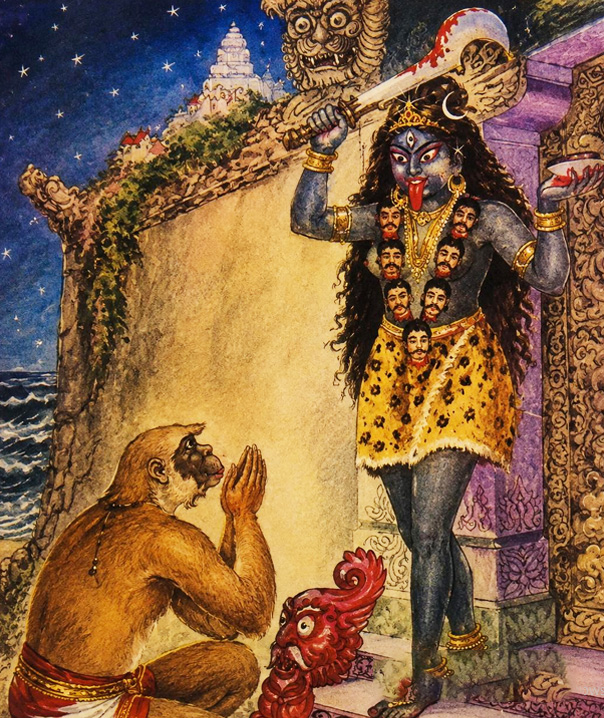
Hanuman and Ma Kali share a deep spiritual connection symbolizing the union of ultimate devotion (Bhakti) and supreme cosmic energy (Shakti). Their most famous interaction occurs in the Krittivasi Ramayana during the rescue of Lord Rama from the demon Mahiravana, where Hanuman encounters the goddess and subdues Mahiravana's sacrificial rites.

When the demon Mahiravana kidnaps Rama and Lakshmana to sacrifice them to Ma Kali in the netherworld, Hanuman shrinks to the size of a bee to rescue them. Hanuman eventually defeats Mahiravana and rescues his lords, earning deep blessings from the goddess.

Hanuman as the Vahana (Mount): In Bengali traditions, Hanuman is sometimes depicted as the vahana (vehicle or guardian) of Ma Kali. Legends state that impressed by his immense dedication to Rama, Goddess Kali requested Hanuman to serve as her guardian and protector in the Kali Yuga.

Lord Hanuman’s devotion toward Maa Kali reflects the meeting of fearless strength and supreme Shakti in sacred reverence. Though known as the embodiment of unwavering devotion to Lord Rama, Hanuman also recognizes the boundless power of the Divine Mother in her fierce form. In Kali he beholds the cosmic force that destroys evil and protects righteousness, and his humility before her reveals that true strength bows before higher truth. His devotion is not born of fear but of recognition—warrior energy honoring the source of all power. Through this reverence, Hanuman demonstrates that courage and surrender are not opposites but companions on the spiritual path. In this union of bhakti and Shakti, devotion becomes strength and strength becomes divine service.

As Hanuman is a Chiranjeevi (immortal), he continues to live on earth guarding Goddess Kali temples.

Thus in Kali Yuga, Hanuman is the Vahana of Goddess Kali and protector of her devotees on earth.

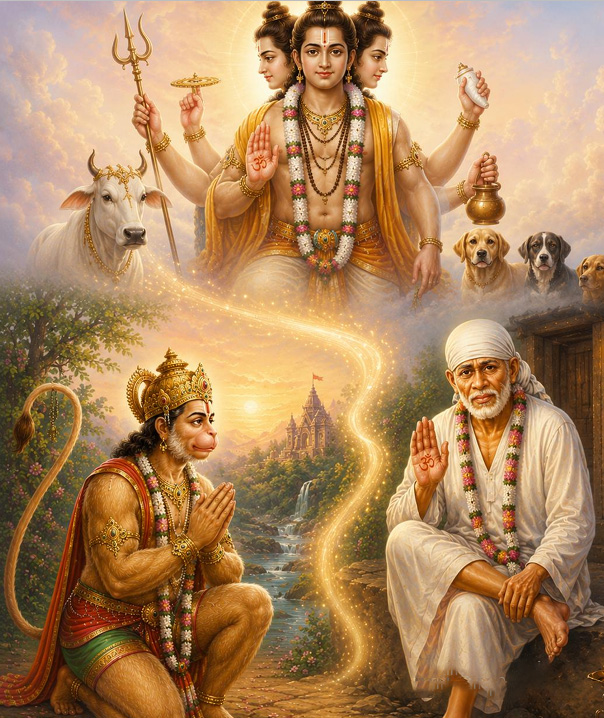
Hanuman As Shirdi Sai Baba

Shirdi Sai Baba had a deeply revered, spiritual connection with Lord Hanuman, often referring to him as his brother. In Shirdi, the Hanuman Temple (Maruti Mandir) located between Dwarkamai and Chavadi was highly significant to Baba. During his daily Chavadi procession, Baba would stop at this temple, wave his hands, and make gestures that seemed to be a silent conversation with Hanuman.According to the Sai Satcharitra, Baba explained these gestures to his devotee Shama, stating, "In my childhood my parents dedicated me to Maruti [Hanuman], and so I make signs at him to remind him I am his brother." During his lifetime, Baba would sometimes experience a spiritual trance in front of the Hanuman Temple, requiring devotees to support him until he reached the Chavadi.Many devotees view this close bond as a reflection of Baba's own Hanuman swarupa (embodiment), recognizing that Baba shared Lord Hanuman's traits of unwavering devotion, immense spiritual strength, and selfless service.

According to the Sripada Srivallabha Charitamrutam, Shirdi Sai Baba is an incarnation of Lord Hanuman. Chapter 45 of this sacred text describes a profound dialogue where Sripada Srivallabha (the first incarnation of Lord Dattatreya) tells Hanuman to take birth in Kali Yuga to pacify humanity's senses.

Sripada bestows upon him the title of 'Sai' and formally grants him union with Lord Dattatreya.

Hanuman agrees to move about as a servant of the divine and declares he will use the phrase "Allah Malik" to guide his devotees.

Extarct from Sripaada Srivallabha Charitamritham, Chapter 45

Sripada Shri Vallabha granted darshan to Hanuma who was in deep meditation of Rama-naama on a mountain, as Sita RamaLakshmana Bharata Satrughna.

He said to Hanuma, “My dear Hanumaa! It cannot becounted as to how many crores of times you chanted the agni beeja (seed word of fire) ‘Ram’. You are reciting ‘Ram beeja’ even during shortspells of time. Chitragupta is finding itdifficult to keep your account. He is non pulsed. Even during the grand infinite maha soonyakaala You are chanting crores and crores o fRama-naama .Therefore, you transcended time. You became kaalaatmaka. Chitragupta is at a loss to reckon your age as so many lakhs of years. You have to incarnate once in this kali yuga. As you are capable of pacifying thetendencies of senses may you become famous with the name of Sai.

The efficacy of ‘Ram’ Seed - Then Hanuma said like this, “My Lord! ‘Ram’ seed is no doubt fiery seed! It is also a fact that I won the favour of Fire God! It is also a fact that I became perfect by union withfire! From the view of body I am your servant. From the view of life force I am your part.From the view point of aatma I am you. Kindly tell in which form I should incarnate.” Sri Sreepada smiled and said, “Even though you were born out of the divine origin of Shiva, you became a devotee of Rama. In Arabic language ‘Aal’ means Shakti , ‘Aaha’ means Shaaktha i.e., one who holds Shakti. Therefore, ‘Allah’ means the combined form of Shiva and Shakti. All along the time you worshipped Me in theform of Janaki Vallabha. Hence forth you adore Me as Shiva-Shakti by uttering the name of ‘Allah’ which is acceptable to ‘Mlechhas’ (people of foreign origin).”

Then Hanuma said like this, “Lord! I know that Sage Bharadwaja conducted ‘Savitrakaathaka Chayanam’ in Pithikapura during treta yuga. I also know that you are born in the lineage of Bharadwaja Sage in compliance with the boon granted on that day. I donot want to be separated from you under any circumstances. Your lineage should be Mylineage also. Am I not your child!”

The dialogue between Sri Sreepada and Sri Hanuman

Then Sri Sreepada said, “My dear Hanumaa! May the body which you assume beborn in the Bharadwaja lineage!” Hanuma again said, “‘Allah Malik’ which means Allah is the master!” Sri Sreepada embraced Hanuma and said, “Hanumaa! Abandon your bodily idea. You are My part and particle.” Again Hanuma expressed, “Lord! I agree that I am a part andportion of you. Nevertheless, amsaavataaras merge with their original nature after completing their mission on earth. Then those amsaavataaras lose all their value and importance. Therefore, the amsaavataara , which I am going to take must be constantly connected with the moola tattwa and should possess all the wealth of strength and power of your ancient moola tattwa.”

Then Sri Sreepada declared, “My dear Hanumaa! You are very intelligent.May all the strength and supremacy of Mine flourish in you also. I will remainincognito in the body of Narasimha Saraswati in the Kadali Vana for 300 years inyoga Samadhi. Then I will become famous as Swami Samardha in Pragnapura.When the time comes for leaving My mortal body, I will incarnate into you who arein the form of Sai. I will announce unequivocally that My incarnation is within you. You will become famous as My Sarva Samardha Sadguru incarnation.”

Then Hanuma submitted, “Lord! I am your servant from the stand point ofphysical body. So I will move chanting the words “Allah Malik”. From the view as a jeevaatma. I conduct myself in the form of a Guru with a spark of your divinity but, is not ‘Sree Charana’ Lord Datta Him-self! Is it proper that there should be difference between You and me? Non-duality will be accomplished only if I change as You, and You change as me. So kindly grant me absorption into the essential nature of Lord Datta.” Sreepada Sreevallabha commanded kaala purusha to attend before Him. Then that great prosperous Lord ordered, “Kaala purushaa! This Hanumasurpassed you and became a kaalatheetha (one who transcended time). I wish togrant Him a state of union with Me. I am conferring Him the title ‘Naadha’ also.From henceforth let Him be called ‘Sai Naadha!’ I am deciding this day as Datta Jayanti. The consciousness in Hanuma may be suitably changed and transformed as Datta swaroopa.

Still Have Question?

Talk To Astrologer Balaji Guruji

Get Instant Solution To Your Problems

WhatsApp Live Chat 9148486969